You took your puppy outside 20 minutes ago.
Now there is pee on the floor, and you are wondering how you can possibly take them out any more often than you already are.
The confusing part is that there is no single potty interval that works for every puppy. An 8-week-old puppy usually needs very frequent opportunities while awake, but even a 5-month-old may suddenly need to go sooner after a big drink, an exciting play session, or waking from a nap.
This puppy potty training schedule by age gives you a practical place to start from 8 weeks through 6 months — without treating your puppy like a timer.
The most important thing to understand:
How long your puppy may be physically capable of holding their bladder is not the same as how long you should wait between potty trips while they are awake and still learning.
Puppy Potty Training Schedule by Age
Use these intervals as conservative starting points during awake time. If your puppy has an accident before the next scheduled trip, shorten the interval.
| Puppy Age | Starting Potty Interval While Awake | What to Expect |
|---|---|---|
| 8 weeks | About every 30–45 minutes | Very close supervision and frequent trips |
| 9–10 weeks | About every 45–60 minutes | Still very easy to miss the window |
| 11–12 weeks | About every 60–90 minutes | Some puppies can begin stretching gradually |
| 3–4 months | About every 1–2 hours | More control, but activity still changes timing |
| 4–5 months | About every 2–3 hours | Gradually increase only when reliability supports it |
| 5–6 months | About every 3–4 hours | Many puppies improve significantly, but supervision still matters |
Quick Tip
Do not increase the interval just because your puppy reached the next age on this chart. Let your puppy’s actual reliability tell you when they are ready.
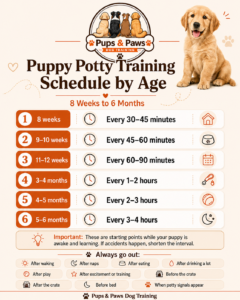
Practical awake-time potty intervals for puppies from 8 weeks to 6 months.
Bladder Capacity Is Not the Same as a Potty Schedule
This is where a lot of puppy owners get misleading advice.
You may hear a formula that says a puppy can hold their bladder for a certain number of hours based on age. That can be useful as a rough estimate of maximum physical capacity under certain circumstances.
But maximum capacity is not what I use to build an active potty-training schedule.
A puppy sleeping quietly in a crate is different from a puppy who just woke up, drank water, chased a toy across the living room, trained for five minutes, and then got excited because somebody came through the front door.
During potty training, the goal is to get outside before your puppy desperately needs to go. Prevention gives them more opportunities to practice the right habit.
What the Schedule Looks Like at Each Age
8 Weeks: Start Around Every 30–45 Minutes
An 8-week-old puppy needs a lot of management. Start with very frequent potty opportunities while awake, plus trips after every major transition. If accidents happen before 45 minutes, shorten it. Thirty minutes is not excessive if that is what keeps your puppy successful.
9–10 Weeks: Start Around Every 45–60 Minutes
You may begin seeing slightly more control, but this is still a very young puppy. Do not assume one accident-free hour means they are suddenly ready for two or three hours of unrestricted indoor freedom.
11–12 Weeks: Start Around Every 60–90 Minutes
If your puppy has been consistently successful, you can begin testing slightly longer intervals. Increase gradually rather than jumping from one hour to three because a chart says your puppy is old enough.
3–4 Months: Start Around Every 1–2 Hours
Many puppies are becoming easier to read at this age, but excitement can still shorten the window dramatically. A puppy who normally handles two hours may still need to go immediately after wrestling with another dog for 15 minutes.
4–5 Months: Start Around Every 2–3 Hours
This is where owners often relax supervision too quickly because the puppy has been doing well. More reliability should earn more freedom gradually. It does not mean every door in the house needs to open at once.
5–6 Months: Start Around Every 3–4 Hours
Many puppies can comfortably manage longer stretches by now, but age still does not guarantee reliability. If accidents return, shorten the interval and increase supervision before assuming your puppy suddenly “forgot” their training.
These Potty Trips Override the Clock
Even if your next scheduled potty trip is not due yet, take your puppy outside:
Learn Your Puppy’s Potty Signals
The behavior usually starts before the puddle.
Your puppy may suddenly start sniffing, circle, wander away from you, stop playing, pace, head toward the door, become restless, or start panting when panting does not make sense for the situation.
Do not wait to see whether they make the signal more obvious. Take them outside. The more accidents you prevent, the more practice your puppy gets doing the right thing.
Quick Tip
If your puppy routinely has an accident at 55 minutes, your current schedule is not one hour. For now, your schedule is probably closer to 40–45 minutes.
What Should My Puppy Do Between Potty Trips?
Very young puppies should not have unrestricted access to the entire house.
When your puppy is awake, supervise them closely. A house leash can help keep an investigative puppy near you instead of quietly disappearing behind the couch.
Use gates or limited areas when they make supervision easier. When you cannot supervise appropriately, the crate can prevent your puppy from wandering off and practicing indoor accidents.
Freedom comes gradually as reliability improves. Management is not separate from training. It is part of how you prevent the behavior you do not want while your puppy is still learning.
What If My Puppy Pees Right After Coming Back Inside?
You stood outside for ten minutes. Your puppy inspected every blade of grass, came inside, and immediately peed.
Usually, the problem is not that your puppy was plotting against you.
They may have been distracted outside. They may not have completely emptied their bladder. Or the outdoor trip may have turned into playtime instead of a focused potty opportunity.
Use the No-Potty Reset
If your puppy does not potty during the focused opportunity outside, return inside, use the crate for approximately 15–30 minutes, and then try again. Do not immediately give full household freedom to a puppy who probably still needs to go.
What If Accidents Keep Happening Anyway?
A schedule helps, but accidents give you information. Before deciding that potty training “isn’t working,” look at what happened immediately before the accident.
The Interval Is Too Long
Shorten it. Preventing the next accident matters more than proving your puppy should be able to wait longer.
Your Puppy Was Distracted Outside
Keep the potty trip focused. Give them the opportunity to finish before turning the outing into play or exploration.
A Signal Was Missed
Start watching what happens in the minute or two before an accident. That pattern may become your puppy’s early warning system.
There Is Too Much Indoor Freedom
Reduce the area your puppy can access and increase supervision until reliability improves again.
The Household Is Following Different Routines
Make sure everyone knows the current potty interval, common signals, and what happens when the puppy does not potty outside.
When to Call Your Veterinarian
If your puppy suddenly starts urinating much more frequently, seems uncomfortable while urinating, drinks an unusual amount of water, has a sudden unexplained regression, or you notice other concerning symptoms, contact your veterinarian. Training schedules cannot rule out a medical issue.
Should I Wake My Puppy Up to Pee at Night?
Very young puppies may still need nighttime potty trips. There is no magic age when every puppy suddenly sleeps through the night.
Take your puppy out immediately before bed. If they wake, become restless, or begin communicating that they need to go, keep the trip calm and focused: outside, potty, then back to bed.
As your puppy begins sleeping longer without accidents, nighttime trips can naturally decrease. You do not need to wake a comfortably sleeping older puppy forever just because an old schedule says it is potty time.
Common Mistake
Do not try to make potty training easier by routinely withholding normal access to water. Build the potty schedule around your puppy’s needs instead of trying to make the puppy fit the schedule.
Free Puppy Potty Training Schedule + Daily Tracker
Knowing the recommended interval is helpful. Tracking your own puppy for a few days is what helps you see their real pattern.
Get the 2-page printable with the age-based quick-reference schedule plus a daily potty tracker to record successful trips, accidents, meals, naps, potty signals, and patterns.
Helpful Potty Training Tools
You do not need a house full of puppy gadgets. A few practical tools can make supervision, communication, cleanup, and prevention much easier.
Appropriately Sized Crate
Useful when you cannot actively supervise and for the No-Potty Reset.
Potty Bell
A simple communication option for puppies learning how to tell you they need access to the door.
Standard or House Leash
Helps keep a puppy close enough to supervise instead of quietly wandering away.
Enzymatic Cleaner
For thoroughly cleaning indoor accidents rather than treating the accident as a punishment opportunity.
Baby Gate
Useful for limiting access to rooms your puppy is not ready to explore unsupervised.
See My Recommended Potty Training Equipment & Tools
A Schedule Tells You When. The Complete Plan Goes Further.
Why Does My Puppy Keep Peeing in the House?
A Simple Potty Training Plan for Fewer Accidents, Clear Signals, and Lasting Results
A potty schedule tells you when to take your puppy outside.
The book teaches the complete system around that schedule, including preventing accidents before they happen, supervision, recognizing potty signals, crate use, handling accidents correctly, household consistency, nighttime potty training, gradually increasing freedom, and troubleshooting when progress gets stuck.
If you need more than a schedule and want the full step-by-step potty-training plan, the book is available on Amazon.
Puppy Potty Training Schedule FAQ
How Often Should an 8-Week-Old Puppy Go Outside?
Start around every 30–45 minutes while your puppy is awake, plus immediately after waking, naps, meals, significant drinking, play, excitement, and crate time. Some puppies need even shorter intervals at first.
How Often Should a 12-Week-Old Puppy Pee?
A practical starting point is about every 60–90 minutes while awake. Continue taking your puppy outside after important transitions even if the scheduled interval has not passed.
How Long Can a Puppy Hold Its Bladder?
Physical bladder capacity increases as puppies mature, but maximum holding ability should not be used as your normal awake potty-training interval. Active, excited, recently fed, or recently hydrated puppies often need to go much sooner.
Should I Wake My Puppy Up to Pee at Night?
Very young puppies may still need nighttime trips. If your puppy is sleeping comfortably for longer stretches without accidents, those trips can gradually decrease. There is no universal age when every puppy must sleep through the night.
When Can I Increase the Time Between Potty Breaks?
Increase the interval gradually after your puppy has been consistently successful at the current interval. If accidents return, shorten it again. Progress matters more than reaching a particular number of hours by a particular birthday.
Why Does My Puppy Pee Inside Right After Being Outside?
Your puppy may have been distracted, may not have fully eliminated, or may have spent the outdoor trip exploring instead of pottying. Use a focused potty trip and the 15–30 minute No-Potty Reset before trying again.
How Long Does Puppy Potty Training Usually Take?
There is no reliable deadline that applies to every puppy. Age, previous habits, supervision, household consistency, individual development, and how often the puppy gets to practice the correct behavior all affect progress. Think in terms of increasing reliability rather than a specific finish date.
Related Puppy Potty Training Resources
Start With the Interval Your Puppy Can Actually Handle
If accidents keep happening, do not wait longer and hope your puppy figures it out. Shorten the interval, supervise more closely, watch the signals, and give your puppy more chances to practice getting it right.